
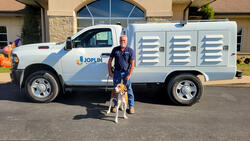
The Animal Control Division helps maintain the safety of residents and a standard of care for their pets. They are responsible for:
- Enforcing the animal control ordinances of the City
- Providing education to the public regarding animal control and protection
On this page
News
Events
Pet Licenses
- Dogs and cats over four months must have a City license
- You can get an animal license at Joplin City Hall, 602 S. Main from the Finance Department on the third floor
- If the animal has been spayed or neutered, the license is free
- If the animal has not been spayed or neutered, there is a $20 license fee
Small Animal Permit
- Small animals (rabbits, hares, chickens, etc.) need a permit
- Contact the Joplin Health Department at 417-623-6122 to have an Animal Control Officer inspect your property to make sure proper requirements are met
- Roosters are prohibited
Spay and Neuter
- The Joplin Humane Society handles spays and neuters
- The Health Department provides financial assistance to supplement the cost, as funds allow:
- Vouchers cover up to $65
- Applications can be picked up at the Joplin Health Department office at 321 East 4th Street in Joplin
- Applicants must live in Joplin city limits and meet income requirements
- Animals must live with the applicant and be current on their rabies vaccinations
Lost Animals
- Animals that are picked up are taken to the Joplin Humane Society
- If your animal is missing, visit the Joplin Humane Society at 140 East Emperor Lane or call 417-623-3642
- If your animal is impounded, you will have to pay impoundment fees set by the Joplin Humane Society before getting your animal back.
- Municipal citations may be issued to the owner of an impounded animal:
- If convicted of a code violation, you may be fined or have to spend time in jail
- If you receive multiple convictions, you may be ordered to forfeit all animals for a time period determined by the judge
- Municipal citations may be issued to the owner of an impounded animal:
Animals at-Large
- To report an animal running at-large:
- Call the Health Department at 417-623-6122 option 3, between 8:00 am and 5:00 pm, Monday to Friday
- Call the Joplin Police Departments non-emergency line at 417-623-3131 after normal business hours, on weekends and holidays. They will contact the Animal Control Officer. Services are limited during these after-hours calls.
- Owners must keep pets under proper restraint, which may include:
- A secure building
- A fenced area
- A chain or cable for less than 30 minutes at a time (chains or cables may not be used for long period of time)
- On a leash at heel of competent person
Animal Trapping
Resident can get a live animal trap on loan from the Health Department, when traps are available:
- To request a trap, call 417-623-6122 at the first of the week
- Traps are available on a first come, first serve basis, weather permitting
- Owners must be home at the time of the trap setting and have bait available
- Traps are set for the week at a residence
- Traps are not set during inclement weather or when Animal Control Officers are not available to monitor the traps
- When an animal is captured, notify the Health Department to send an Animal Control Officer for removal
Citizens are allowed to set their own, private live animal traps:
- Traps must be set on your own property
- If an animal is captured, notify the Health Department to send an Animal Control Officer for removal
- Only live wild animal traps are allowed
Animal Care Standards
Pet owners must provide care for their dogs and cats. Minimum care requirements for pet dogs and cats include:
- Suitable shelter should be provided for animals kept outside. Shelter must meet shelter standards:
- Safe, clean and weatherproof, and fits the animal(s) size, age and needs
- Includes a floor, wall, roof and an entrance door or flap that protects the animal from wind and rain
- Drains well so water does not pool in the shelter
- Dry, well-ventilated, free of hazards and provides share in the summer and protection from rain, wind and cold
- Large enough for the animal(s) to stand, sit, lie down comfortably and turn around freely
- When the temperature is 50°F (10°C) or below, animals must be provided with clean, dry bedding
- When the temperature is 35°F (1.7°C) or below, animals must have clean and dry bedding that is deep enough for the animal to nest in
- Unacceptable shelter includes, but is not limited to, barrels, crates, cardboard boxes, tarpaulins, and similar
- Animals need adequate shade area(s) large enough for all animals to be out of the sun's direct rays throughout the course of the day
- Animals must be provided adequate care and proper shelter if they are sick, injured, elderly or under six months old
- Animals must have food suitable for the animal and access to fresh, clean, unfrozen water
- Animals need normal and prudent care, including exercise and veterinary care
- Animals must have rabies vaccinations administered by a licensed veterinarian
Dangerous or Potentially Dangerous Animals
- Dangerous or potentially dangerous animals are often dogs that have aggressively attacked or bitten a person or animal
- Owners of potentially dangerous or dangerous animals may be issued a municipal citation
- If an owner is found guilty, sanctions may be imposed upon them or their animal
Animal Bites
- If you are bit by an animal, domestic or wild, an Animal Control Officer will investigate the circumstances of the bite
- Joplin Health Department must ensure that the animal is properly quarantined to ensure rabies is not present
- Quarantine periods are 10 days from the date of the bite
- Depending on the nature of the bite, the quarantine may occur at the Joplin Humane Society, a veterinarian's office, or at the home of the owner
- The cost of an impoundment fee will be paid by the animal's owner
- Victims of animal bites should consult a physician
Filing a Complaint
- To make a complaint about an animal in city limits:
- Call the Health Department at 417-623-6122 option 3, between 8:00 am and 5:00 pm, Monday to Friday
- Call the Joplin Police Departments non-emergency line at 417-623-3131 after normal business hours, on weekends and holidays. They will contact the Animal Control Officer. Services are limited during these after-hours calls.
- When calling in a complaint, provide a brief explanation of the situation, a description on the animal and the address or location of the animal
- In some situations, you many need to sign a municipal citation to address an animal control problem:
- This includes situations where an Animal Control Officer does not witness the event
- In these cases, you would need to attend municipal court to testify on behalf on their complaint